
How Much Does a Humanoid Robot Cost? (2026 Price Guide)
In 2026, public starting prices run from roughly $4,000–$16,000 for compact consumer, education, and entry-research models to about $90,000 for full-size research platforms; industrial deployments can cost substantially more. The price gap has little to do with how human the robot looks — it comes down to degrees of freedom, joint actuator performance, sensors, and how open the software stack is.
Humanoid robot price tiers (2026)
| Tier | Representative positioning | Price range | Best for |
|---|---|---|---|
| Consumer / education | Compact biped, e.g. Unitree R1 (announced at about $5,900) | $4k–$16k | Teaching, demos, hobbyist development |
| Entry research | Mid-size platform, e.g. Unitree G1 (about $13,500 starting price) | $13k–$30k | University courses, RL experiments, algorithm validation |
| Full-size research | Full-size biped, e.g. Unitree H1 (~$90,000) | $30k–$90k | Locomotion research, embodied-AI labs |
| Industrial / commercial | Factory-grade robots and turnkey solutions | $100k+ | Production pilots, scaled deployment, OEM programs |
These figures establish budget scale and were checked against vendor product pages or public launch information on 2026-07-27. Taxes, shipping, service contracts, dexterous hands, compute, and sensors can materially change the final quote.
Where the money actually goes
- Degrees of freedom. DOF count sets the number of actuated joints. A 20-DOF robot and a 30+ DOF robot sit a full price tier apart on actuators alone.
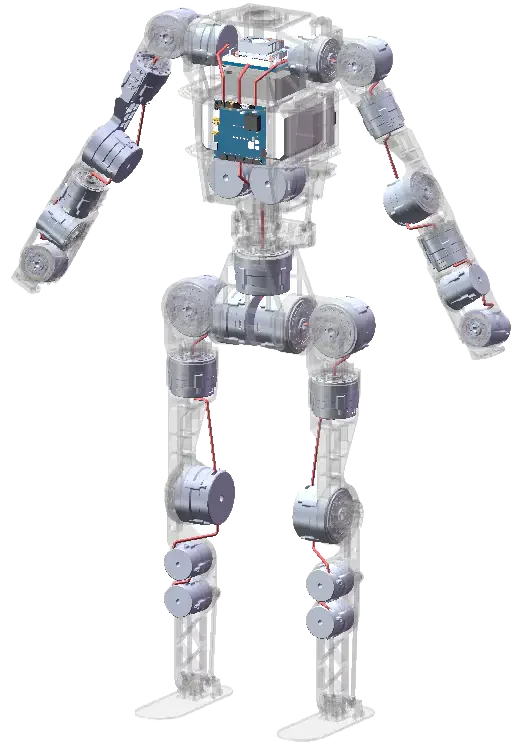
- Joint motors. Joint motors are often one of the largest hardware cost groups, but their share varies substantially with DOF, sensors, compute, and end-effectors. Higher torque, torque density, and encoder performance generally raise per-unit cost.
- Sensors and compute. LiDAR, depth cameras, IMUs, force/torque sensors, and the onboard compute module can swing the price by thousands of dollars between configurations.
- SDK, simulation, and support. An open SDK, simulation models (MuJoCo / Isaac Lab), documentation, and responsive support determine whether the robot is usable the week it arrives. That cost is baked into the price — and often the difference between tiers.
- Openness for secondary development. Research platforms cost more partly because they expose low-level joint control, data-logging channels, and modifiable hardware. Consumer models typically lock all of that down.
Best humanoid robot under $20,000?
Under $20,000 you are mainly shopping compact consumer, education, and entry-research platforms. They can suit coursework, demos, and early reinforcement-learning work, but buyers should verify low-level access, payload, joint torque, and simulator support rather than assume these capabilities from price alone.
How to evaluate a research humanoid for the price
If you are buying a humanoid robot for research, score candidates on four axes rather than sticker price alone:
- DOF and joint performance. DOF caps what motions are possible; peak joint torque caps how dynamic they can be. The BXI Elf 3 humanoid robot, for example, has 31 DOF and walks at up to 5 m/s, driven by BXI's in-house 85/70/50 series joint motors with 25–150 N·m peak torque — the same field-validated actuators from load-bearing legs to dexterous arms.
- SDK and simulation support. Insist on ROS2 and a model for a mainstream simulator. Elf 3 ships with a ROS2 SDK and a MuJoCo simulation model, so a sim-to-real workflow works out of the box.
- Data collection. Embodied-AI research runs on data: check joint-state feedback rates, teleoperation interfaces, and demonstration-data export before you sign.
- Support and customization. Labs always end up modifying hardware — end-effectors, extra sensors, structural changes. A vendor with a real OEM and customization program keeps those costs sane later.
FAQ
How much does a humanoid robot cost in 2026?
Roughly $4k–$16k for consumer/education bipeds, $15k–$90k for research platforms (full-size at the top of that range), and $100k+ for industrial and commercial systems, depending on DOF, torque, sensors, and software.
Is there a humanoid robot for sale to individuals?
Some compact bipeds are sold directly in selected markets. Research and industrial platforms are more commonly sold through project quotes, regional distributors, or B2B support contracts; availability should be confirmed with the vendor.
What is the difference between a research and a consumer humanoid?
Openness and performance ceiling: research platforms expose low-level joint control, ship a ROS2 SDK and simulation models, and use higher-torque joints with more DOF. Consumer models are closed, lower-torque, and built for demos rather than experiments.
What should I check before buying a research platform?
Four things: DOF and peak torque matched to your research goals; SDK/simulation support (ROS2, MuJoCo, Isaac Lab); data collection and teleoperation capability; and after-sales plus customization options. Ask for a live demo and simulator access before committing.
Get a quote for the BXI Elf 3
Elf 3 pricing depends on configuration — dexterous hands, compute, sensors, and any customization — so we quote per project rather than posting one number. Contact us with your research goals and budget range and we'll propose a configuration, or start with the Elf 3 product page and the joint motor specs.
Price sources
Source list updated July 27, 2026. Confirm current prices with the vendor because region, configuration, tax, and shipping can change the total.