
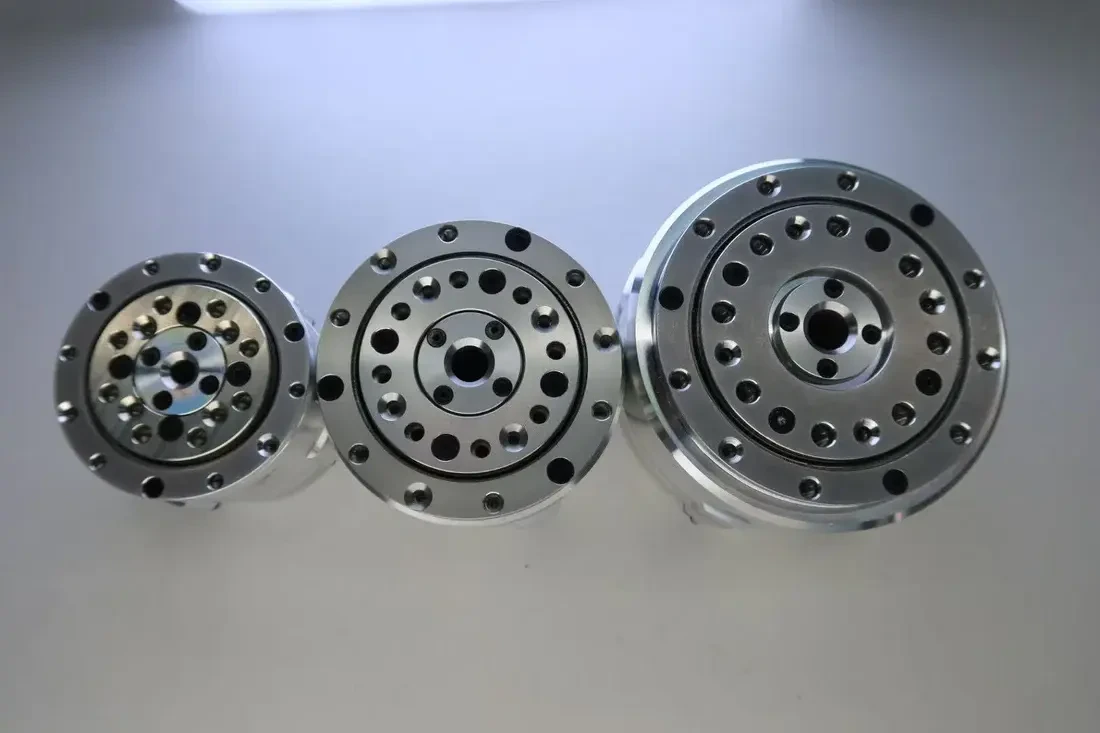
BXI 85/70/50 Joint Motor Selection Guide
BXI Robotics joint motors use a hollow-shaft planetary reduction design, with dual absolute encoders (magnetic input + inductive output) and cross-roller bearings across the lineup, plus MIT-protocol-compatible CAN/CANFD communication. The actuators have been validated on multiple humanoid platforms under defined test conditions, and their modular design fits both robotic arms and legs in high-DOF embodied systems. This guide gives the full specs of the four main models, a breakdown of what each parameter means, and a practical workflow so engineering and procurement teams can select by torque and size.
Full spec table
| Parameter | BXI8515-19 | BXI7010-19 | BXI5018-19 | BXI5014-19 |
|---|---|---|---|---|
| Rated torque | 40 N·m | 15 N·m | 11 N·m | 7 N·m |
| Peak torque | 150 N·m | 50 N·m | 35 N·m | 25 N·m |
| Rated voltage | 24–48 V | 24–48 V | 24–48 V | 24–48 V |
| No-load speed | 200 rpm | 200 rpm | 200 rpm | 200 rpm |
| Rated output speed | 100 rpm | 100 rpm | 100 rpm | 100 rpm |
| Peak phase current | 90 A | 60 A | 30 A | 30 A |
| Reduction ratio | 19.5 | 19.5 | 19.5 | 19.5 |
| Weight | 1.4 kg | 0.8 kg | 0.55 kg | 0.5 kg |
| Installation diameter | 99 mm | 81 mm | 64 mm | 64 mm |
| Height | 73 mm | 68 mm | 70.5 mm | 66.5 mm |
| Hollow bore | 10 mm | 9 mm | 6 mm | 6 mm |
| Encoder | Dual absolute (magnetic input + inductive output) | Same | Same | Same |
| Bearing | Cross-roller bearing | Same | Same | Same |
| Communication | CAN / CANFD | CAN / CANFD | CAN / CANFD | CAN / CANFD |
Values are theoretical; actual values may vary by operating conditions. The first two digits denote the frame-size series (85/70/50), and the -19 suffix corresponds to the ~19.5 reduction ratio.
How to read the key parameters
Understanding a few parameters up front avoids trial-and-error over "is the torque enough":
- Rated vs peak torque: rated torque is what the motor can output continuously — use it for sustained holding and steady-state loads; peak torque is the short-duration ceiling — use it for start-up, impact, and dynamic swings. Keep continuous operation within rated torque and reserve peak torque for transients.
- 19.5 reduction ratio: the whole lineup uses a 19.5 planetary ratio, trading speed for torque — output speed is about 1/19.5 of motor speed, which is why rated output speed is a uniform 100 rpm. A common ratio means torque scales mainly with frame size, so selection comes down to matching a "torque tier".
- 24–48 V rated voltage: compatible with common robot bus voltages and reusable across 24 V and 48 V systems.
- Peak phase current: reflects the current the drive must supply — larger frames demand more (90 A on the BXI8515-19) — size your power supply and drive headroom accordingly.
- Weight and end-effector inertia: joints closer to the end (wrist/hand) should use lighter models; lower end inertia helps dynamic response and energy use — the 5014/5018, as light as 0.5 kg, are built for exactly this.
A three-step selection workflow
- Set the torque tier: estimate the continuous holding torque and peak impact torque in the worst-case pose, then shortlist models — match holding torque to rated torque and impact torque to peak torque.
- Check size and weight: among models that meet the torque requirement, prefer the smaller-diameter, lighter one — especially for distal arm joints — to cut inertia and overall weight.
- Verify routing and interface: confirm the hollow bore can carry your cables and sensor wiring (6–10 mm options), and standardize CAN/CANFD communication and bus voltage.
How to choose: match torque to joint location
- High-torque leg joints (hip/knee): choose the BXI8515-19 (150 N·m peak) for sufficient support and dynamic torque.
- Primary arm joints (shoulder/elbow): choose the BXI7010-19 (50 N·m peak) to balance torque and weight.
- Lightweight distal joints (wrist/end): choose the BXI5018-19 / BXI5014-19 (35 / 25 N·m peak), as light as 0.5 kg to reduce end-effector inertia.
Core technology: hollow shaft + dual absolute encoders + cross-roller bearings
- Hollow-shaft planetary reduction: the large-diameter hollow output frees routing space for cables, hydraulics, and sensor modules, greatly simplifying whole-robot wiring and increasing joint range of motion; planetary reduction balances torque density with a compact structure.
- Dual absolute encoders: one absolute encoder on each of the input and output sides measures the true output angle directly, delivering higher closed-loop control accuracy and enabling power-on without homing — the joint position is known at boot, with no zeroing routine.
- Cross-roller bearings: a single bearing handles radial, axial, and moment loads simultaneously, improving joint stiffness and rotational accuracy — ideal for load-bearing joints.
Communication and control: CAN/CANFD + MIT protocol
The whole lineup uses CAN / CANFD and is MIT-protocol compatible, supporting hybrid torque / speed / position control for high-bandwidth, low-latency multi-joint coordination on a single bus. On high-DOF robots, pair them with the PCIE-CAN control modules (up to 24 CAN buses, 1 kHz control) for centralized scheduling; the Elf 3 humanoid robot uses a PCIE-CANFD architecture to reach a >1000 Hz whole-robot control rate.
Validated on whole robots
The 85/70/50 series has been validated on multiple humanoid platforms under defined test conditions and is used across the Elf 3 joint system, from load-bearing legs to arm manipulation.
FAQ
What is the torque range? Rated torque 7–40 N·m and peak torque 25–150 N·m across the lineup, covering joints from end-effector to leg.
How do I use rated vs peak torque? Select by rated torque for continuous holding and steady-state loads, and by peak torque for start-up, impact, and dynamic swings — leaving headroom for safety.
Which protocols are supported? CAN / CANFD, MIT-protocol compatible, with hybrid torque / speed / position control.
Why dual absolute encoders? Both input and output sides measure the true angle directly, improving closed-loop accuracy and enabling power-on without homing, which simplifies calibration.
Which model for arms vs legs? Use the BXI8515-19 (150 N·m) for load-bearing leg joints, the BXI7010-19 (50 N·m) for primary arm joints, and the BXI5018-19 / BXI5014-19 for lightweight wrist/end joints.
For selection advice or samples, contact us or see the joint motors page.