
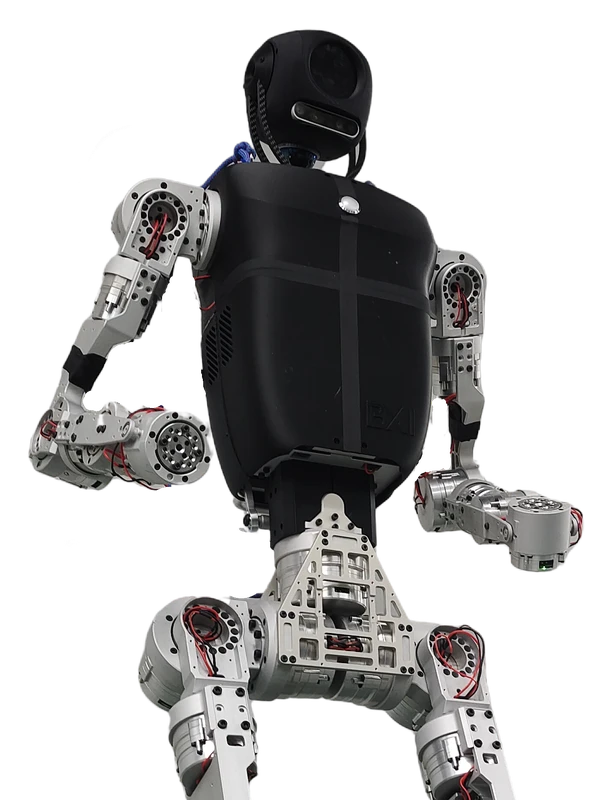
Elf 3 Humanoid Robot: Full Specifications and Applications
The Elf 3 is BXI Robotics' high-performance, general-purpose humanoid robot, featuring an open SDK and a ready-to-deploy system architecture for embodied-AI research, education, and industrial validation. It is built on in-house joint motors, a PCIE-CANFD control architecture, and a ROS2 software stack, and supports both teleoperation and autonomous modes. This article summarizes its full specifications, a breakdown of each subsystem, and typical use cases for engineering and procurement teams.
Specifications at a glance
| Parameter | Value |
|---|---|
| Total degrees of freedom | 31 (excl. hands): 6 per leg + 7 per arm + 3 waist + 2 head |
| Height | 1450 mm |
| Width × Depth | 450 × 280 mm |
| Weight | ≈ 38 kg |
| Max speed | 5 m/s (~18 km/h) |
| Single-arm payload | 5 kg (horizontal, continuous) / 10 kg (elbow-supported) |
| Battery | 518 Wh |
| Runtime | ≈ 1 hour (walking) |
| Joint motors | 31 × BXI hollow-shaft planetary motors (5014/5018/7010/8515 series) |
| Control rate | > 1000 Hz (PCIE-CANFD architecture) |
| Onboard compute | Intel Core i7-1370P / 16 GB / 512 GB |
| Sensors | RealSense D435i depth camera, IMU, 8-mic array |
| Software | Ubuntu 22.04 + ROS2 SDK + MuJoCo simulation |
Degrees of freedom
The 31 DOF break down as 6 per leg, 7 per arm, 3 in the waist, and 2 in the head. The 7-DOF arms enable more human-like manipulation trajectories and cover a wider range of grasping and working poses, while the 3-DOF waist improves whole-body coordination and reachable workspace, making motions like bending and twisting more natural.
Joint motors: the power behind every joint
The robot is driven by 31 in-house hollow-shaft planetary joint motors across three size series (85/70/50), with peak torque from 25 N·m to 150 N·m: high-torque models for load-bearing leg joints, lighter models for arms and end joints to keep inertia low. All use dual absolute encoders (magnetic input + inductive output) and cross-roller bearings, measuring the true output angle directly for high-accuracy closed-loop control and power-on without homing. For per-model specs and a selection method, see the BXI 85/70/50 joint motor selection guide.
Control and compute
The robot uses a PCIE-CANFD control architecture to achieve a >1000 Hz whole-body control rate, providing a low-latency command loop for dynamic balance and whole-body coordination. Onboard compute is an Intel Core i7-1370P with 16 GB of memory and 512 GB of storage, capable of running control and lightweight inference workloads on the body.
Sensing and software
- Sensing: the RealSense D435i depth camera provides RGB-D vision, the IMU is used for pose and balance estimation, and the 8-mic array supports voice interaction and sound-source localization.
- Software stack: built on Ubuntu 22.04 + ROS2, with a hardware control SDK and a MuJoCo simulation environment that support sim-to-real algorithm transfer, plus MIT-protocol-compatible CANFD communication.
Mobility and payload
A top speed of 5 m/s (~18 km/h), single-arm payload of 5 kg (horizontal, continuous) / 10 kg (elbow-supported), and a 518 Wh battery for about 1 hour of walking runtime balance mobility with real working payload.
Typical use cases
- Embodied-AI research: an open ROS2 SDK and MuJoCo simulation environment support sim-to-real transfer for reinforcement learning and motion-control algorithms.
- Education and training: the ready-to-deploy architecture lowers the barrier to entry for university and vocational humanoid-robotics courses.
- Teleoperation and data collection: both teleoperation and autonomous modes are supported for manipulation data collection and demonstration.
- Industrial validation: as a mature whole-robot platform, it serves as a feasibility-validation and secondary-development baseline for embodied solutions.
FAQ
How many degrees of freedom does the Elf 3 have? 31 DOF excluding hands: 6 per leg, 7 per arm, 3 waist, 2 head.
How fast is it and how much can it carry? Top speed of 5 m/s (~18 km/h), single-arm payload 5 kg (horizontal, continuous) / 10 kg (elbow-supported).
What is the runtime? A 518 Wh battery for about 1 hour of walking.
Which joint motors does it use? 31 in-house BXI hollow-shaft planetary joint motors (5014/5018/7010/8515 series), with 25–150 N·m peak torque.
Can the Elf 3 be developed on? Yes. It ships with a ROS2-based hardware control SDK and a MuJoCo simulation environment, and uses MIT-protocol-compatible CANFD communication.
Is OEM/ODM customization available? Yes — branded customization is offered with the Elf 3 as a mature baseline. See the humanoid robot OEM/ODM process.
For the full datasheet, a quote, or an OEM/ODM solution, contact us.