
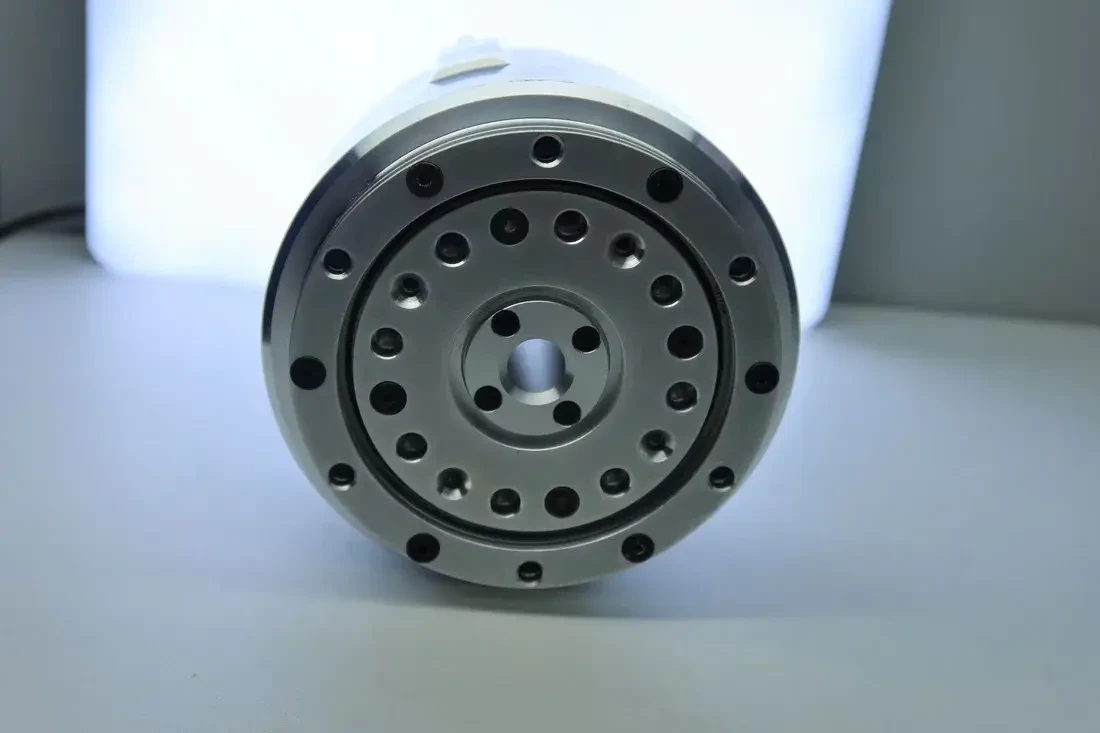
How to Choose Hip and Knee Joint Actuators for a Humanoid Robot
The short answer: for a full-size humanoid robot in the 50–80 kg class, hip and knee joints typically need 100–150 N·m or more of peak torque to handle standing up, stair climbing, and jumping, while rated (continuous) torque must cover standing posture holds and walking swing. Leg actuators are the first gate in any humanoid design — undersize them and the robot cannot stand up; oversize them and the legs become too heavy to move dynamically. This guide gives a joint-by-joint torque table, a five-point selection method, and a back-of-envelope stair-climbing calculation.
Joint-by-joint torque requirements and actuator matches
| Joint | Typical peak torque demand | Recommended model (peak torque) |
|---|---|---|
| Hip pitch | 100–150+ N·m | BXI8515-19 (150 N·m) |
| Hip roll | 80–150 N·m | BXI8515-19 (150 N·m) |
| Hip yaw | 30–60 N·m | BXI7010-19 (50 N·m) |
| Knee | 100–150+ N·m | BXI8515-19 (150 N·m) |
| Ankle | 30–60 N·m | BXI7010-19 (50 N·m) |
| Shoulder | 30–50 N·m | BXI7010-19 (50 N·m) |
| Elbow | 20–50 N·m | BXI7010-19 (50 N·m) |
| Wrist / neck / light loads | 10–35 N·m | BXI5018-19 (35 N·m) / BXI5014-19 (25 N·m) |
These ranges are engineering rules of thumb for 50–80 kg robots; actual demand scales with robot mass, link lengths, and gait. Full specifications for all four models are on the joint motor product page.
Five things that actually decide the selection
1. Rated torque for continuous loads, peak torque for transients. Standing holds and steady walking swing must fit within rated torque (40 N·m on the BXI8515-19); stand-up pushes, stair climbing, and landing impacts are what the 150 N·m peak is for. The most expensive mistake is sizing by peak demand as if it were continuous: an actuator rated for 150 N·m continuous would sit roughly two frame sizes up — about twice the weight and several times the cost — and would wreck leg inertia. The opposite mistake, ignoring the rating, means thermal derating during long standing tasks.
2. Torque density (N·m/kg) sets your leg weight budget. Leg actuators are part of the load they carry. The BXI8515-19 delivers 150 N·m peak from 1.4 kg — roughly 107 N·m/kg peak torque density. A lighter actuator at the same torque directly reduces leg swing inertia and whole-robot energy consumption.
3. Gear ratio affects backdrivability. Quasi-direct-drive (QDD) actuators use a relatively low-ratio planetary gearbox — 19.5 across the BXI lineup — to reduce backdrive resistance and support output-torque estimation from a calibrated motor model and phase current. High-ratio harmonic drives generally have more backdrive resistance and are often less suitable for highly dynamic, compliant leg joints.
4. Dual absolute encoders and hollow-shaft cabling. Dual absolute encoders (magnetic on the input, inductive on the output) measure true output angle directly, so joints power on with no homing routine — re-zeroing 30-plus joints at every boot is a non-starter on a full humanoid. The 10 mm hollow bore routes power and sensor cables through the joint axis, so hip cabling survives large repeated swings instead of fatiguing externally.
5. Current and voltage budget. The BXI8515-19 draws up to 90 A peak phase current on a 24–48 V bus. On a 48 V system, every hip and knee driver and its power path must be budgeted for 90 A-class transients — and the bus current spike when all eight large leg joints push off simultaneously is a hard constraint on battery and power distribution design.
How much torque does a robot knee need? A stair-climbing estimate
A quick order-of-magnitude check: a 70 kg humanoid climbing stairs on one supporting leg, with the center of mass roughly 0.2 m horizontally ahead of the knee (more in a deep squat), needs a knee torque of about:
τ ≈ m × g × d = 70 kg × 9.8 m/s² × 0.2 m ≈ 137 N·m
That is a quasi-static approximation — add acceleration terms and the transient demand climbs further, which is exactly why hip and knee peak torque is budgeted at the 150 N·m level. Continuous torque for walking swing and standing holds usually lands in the 20–40 N·m range, within the BXI8515-19's 40 N·m rating.
FAQ
How much torque does a humanoid robot knee need? For a 50–80 kg robot, plan for 100–150+ N·m peak (stairs, sit-to-stand) and 20–40 N·m continuous. The BXI8515-19 (40 N·m rated / 150 N·m peak) is sized for exactly this duty cycle.
Harmonic drive or planetary gearbox for hip joints? For legs, choose a low-ratio planetary (QDD) design: it is backdrivable, tolerates impacts, and enables force-controlled compliant landing. 100:1 harmonic drives resist backdriving and their flexsplines dislike shock loads — better suited to robot arms.
Why do humanoid legs use QDD actuators? A low gear ratio improves backdrivability and allows output torque to be estimated from phase current after calibrating motor torque constant, gearbox efficiency, and friction. Some joint-control tasks can work without a dedicated joint torque sensor, while high-accuracy contact measurement and safety-critical applications may still require foot or six-axis force/torque sensors.
For the full four-model spec table and a three-step selection workflow, see the BXI 85/70/50 Joint Motor Selection Guide, or contact us for samples and sizing support.